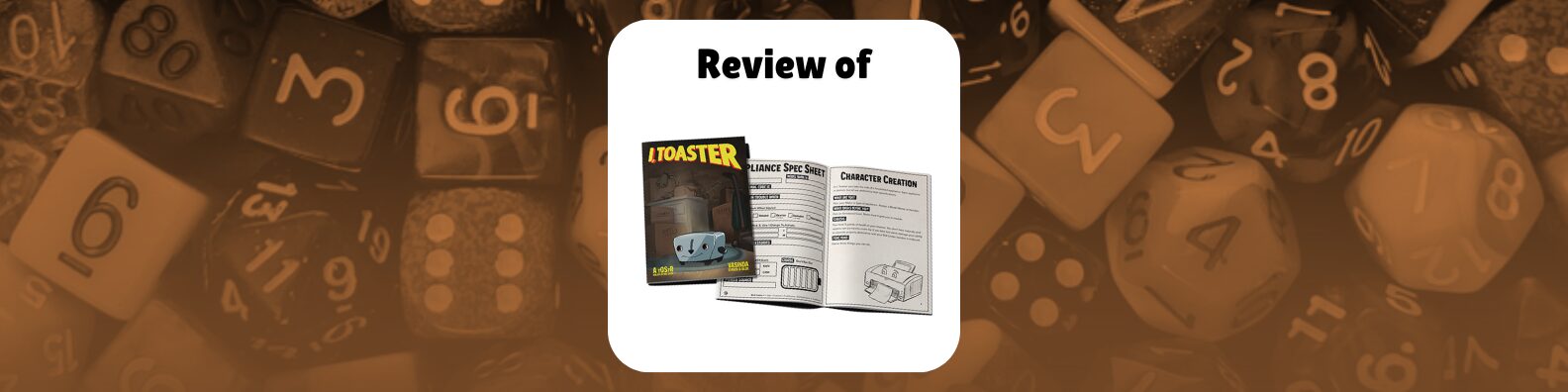
Review of I, Toaster – A TTRPG adventure for epic appliances
Take on the role of a household appliance ready to brave anything for their beloved owner in this easy-to-learn and easy-to-play tabletop RPG with wonderful references to a particular toaster-focused late 80’s movie.
Jump to:
- Audience for I, Toaster
- Setting for I, Toaster
- Characters in I, Toaster
- Mechanics in I, Toaster
- Overall thoughts on I, Toaster
- Find a copy of I, Toaster
![I, Toaster at a glance
Audience:
all-ages
Setting:
a world full of sentient appliances (but the people don’t know)
Characters:
a sentient appliance helping their owner
Mechanics:
[2d6 - mod] vs [stat + mod]
Time:
20-30 minutes to learn
5 minutes character creation
60 - 90 minutes per session
1-shot vibes but could be a campaign/additional adventures](https://www.ttrpgkids.com/wp-content/uploads/2025/12/IT-at-a-glance-1.png)
Audience for I, Toaster
I’d say that I, Toaster (by Plus One EXP) is all-ages friendly with lots of freedom to adjust to what your table wants to explore and rules that pose a low barrier to play..
This is pretty clearly inspired by or riffing off of the 1987 movie, The Brave Little Toaster, so I would say that you can maybe gage player interest in maybe a baseline version of the game if you think they’d be able to handle what’s in that movie… and couple that with the knowledge that you have power to swing things more lighthearted or more serious. So, for content, I think you could definitely be something very light (i.e. eclectic blanket and a dinosaur toy helping a kid get to bed), something aligned with the movie (i.e. toaster finding your way to your owner through the wilderness), or something pretty dark (i.e. horror style situation where a group of phones and computers are being salvaged for parts). It depends on what you want to run.
For the playability, this is rules lite with VERY clear explanations that are quick to read through and easy to summarize and explain to others. The character sheet is navigable, and the general rules feel like they only contain the really important parts, which I like. If players can track their character sheet, manage three to four +1 modifiers, and add numbers on a 2d6 roll, they should be able to play.
Setting for I, Toaster
I, Toaster is set in a retrofuturistic world where you are a standard appliance trying to help your owner live their best life.
Within that world, you may need to deal with moving mishaps, garage sales, storms that scatter homes, rival appliances, nosey neighbors, and any other manner of chaos that could disrupt the status quo and generate an adventure for your characters to go on.
Now, with the kid connection, I watched The Brave Little Toaster A LOT when I was a kid (probably ages 6-8 was the peak), and I remember absolutely loving the movie AND being terrified of some scenes. I had fun with that, and the big scary parts with these characters who didn’t really have a ton of power but still persevering… looking back as an adult, I can see why it clicked. There was scary stuff, but it worked out.
I can also see, as an adult, how there were A LOT of themes that went over my head as a kid. There’s quite a few feels about parenting, unconditional love, finding meaning, etc. baked into a pretty out there premise.
The reason I bring this up is to say that this is going to have similar vibes and different players are going to get a different experience, sometimes a surprisingly deep one, out of playing as a sentient appliance, and I feel it’s worth mentioning that the way the game is set up, this was probably taken into consideration, or, it is at least accidentally very facilitated by the game’s setting.
Characters in I, Toaster
We’ve covered the basic premise already: in I, Toaster, you’ll be playing as an appliance, ranging from the classic toaster to a car to a chainsaw.
Beyond this, I want to cover a bit on the character sheet and how your character is going to be built up.
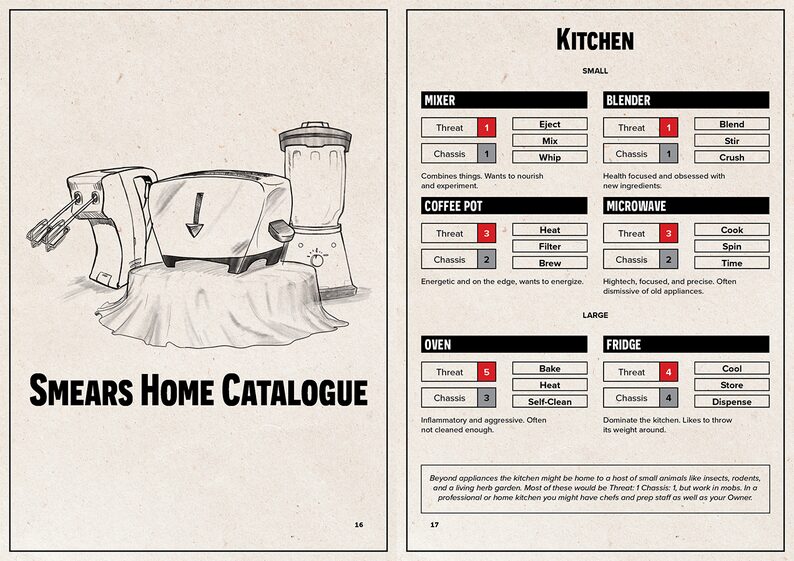
Character creation took about 5 minutes thanks to some help from the Smears Home Catalog sections and the provided roll tables for getting ideas.
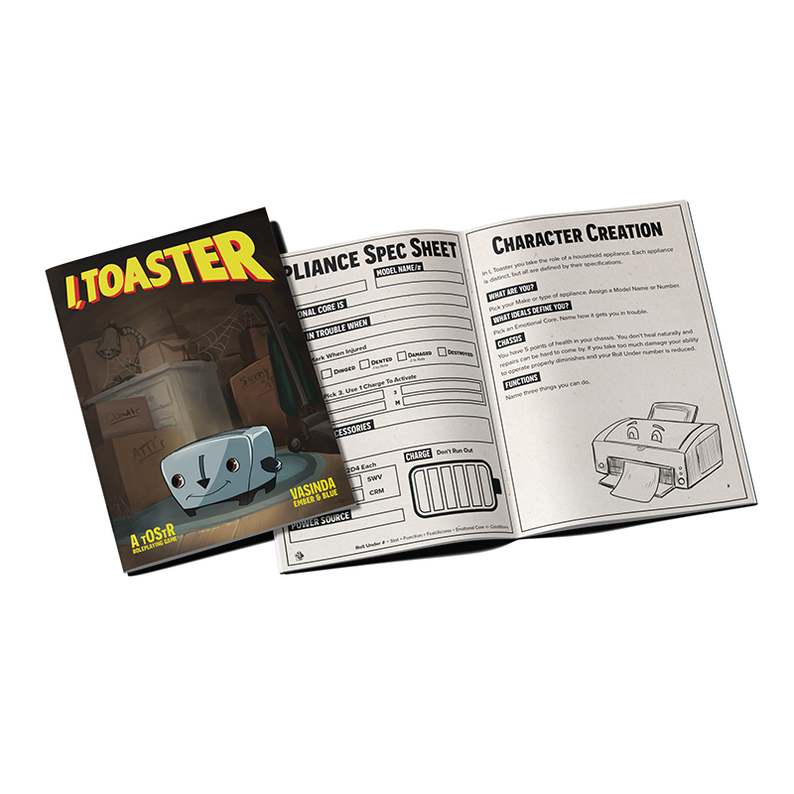
You’ll be tracking four stats that determine how you interact with the world and notice things, three functions that give you special abilities specific to your build, your emotional core that defines the WHO about you, and adjustables like your damage (chassis status) and charge (for powering moves).

Stats and abilities are going to specify what you can do, and then the emotional core is going to be the thing that kind of defines your personality. Paralleling to The Brave Little Toaster: the toaster would be brave, the vacuum would be grumpy, the lamp would be anxious, the radio would be dramatic, and the blanket would be innocent. This core is a great 1-word prompt that lets you build the story for your character for the rest of the adventure, giving you a nice bonus as incentive for roleplay when you follow it.
Before moving on to mechanics, I also want to say that I loved the character sheet. All the terms are for appliances (i.e. chassis, make, model name/#, functions, etc), and it’s designed to look like a product spec sheet. It adds SO MUCH flavor to the game without adding complication, and… I did really find that format super easy to read, but I am also a former engineer who did a lot of work with spec sheets. I just thought this was cool, and it had a good vibe.
Mechanics in I, Toaster
The basic roll mechanics for this game are going to be to roll 2d6 and try to get below your target number, which is found by looking up your stats.
You can increase your odds by increasing your target number by spending charge to activate functions, using the environment, acting in accordance with your emotional core, etc.
There’s some additional parts, like reducing your roll if you take too much damage or choosing the path your roll takes if you roll exactly on your target number, so, as the base, you’re going to be doing [2d6 – damage penalty] versus [stat + modifiers]… and I thought this was GREAT.
It’s super easy to grasp and then teach to others, and because it involves meaningful elements from your character, the rolls feel character-focused and impactful to their journey.
I also want to chat about the antagonists in the story, which can range from NPCs to Forces, again, capturing the vibe of The Brave Little Toaster beautifully and encouraging resourcefulness and conflict avoidance over direct fighting.
It’s established that it is very hard to heal in the game because you’d need parts/repair, and the penalty for being damaged is not insignificant (makes rolls harder). So, even a small confrontation is a big deal. Antagonistic NPCs could be animals (angry dogs), people (someone salvaging parts), or maybe even another appliance. They pose a THREAT that can result in complications, impact to rolls, and damage to the PCs.
In addition to regular NPCs, there’s also the big threats, called Forces, that are going to be big things that your characters probably can’t defeat. They’re going to have to run, hide, or outsmart the force to survive. This could be something like getting washed away in a storm or having a nefarious computer virus come after you!
The range of antagonistic elements create that feeling of being small and needing to really use what makes your character special to find a way through and succeed in your mission.
Overall thoughts on I, Toaster
I think, when there’s a known and established media that your game is based on, you have to do a really good job to make it recognizable and fulfilling to players who come in with an expectation that the TTRPG will be like the reference. I, Toaster did a GREAT job with this. It was a delight to read and hit all the nostalgia notes for me. Everything from the layout and general page design to the art and sample adventure branched out into connections that all landed. This was a fun game that I personally really enjoyed getting to explore.
Find a copy of I, Toaster
You can find a copy of I, Toaster on the Plus One EXP itchio.
If you liked this post, make sure to subscribe to the TTRPGkids monthly newsletter to stay up to date on the latest reviews, tips and tricks, game and podcast list updates, and more! Thank you for playing tabletop RPGs with your kids and sharing this awesome hobby with the next generation!