

Review of Monumental Consequences, a large group TTRPG about if art is worth dying for
Great for kicking off high school and college level debates about art history OR having a social deduction game with friends where you (mostly) don’t have to lie, for those of us who have a bad poker face, Monumental Consequences is a fantastic role-playing game that has you asking… is art ever worth dying for?
- Audience for Monumental Consequences
- Setting for Monumental Consequences
- Your character in Monumental Consequences
- Mechanics in Monumental Consequences
- Overall thoughts on Monumental Consequences
- Find a copy of Monumental Consequences
Audience for Monumental Consequences
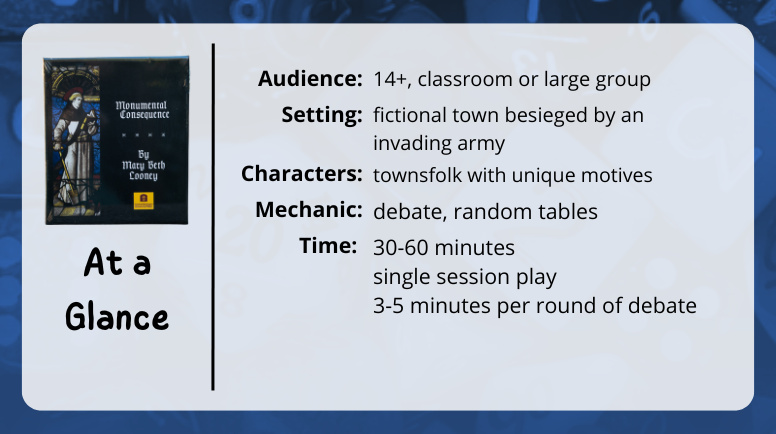
Monumental Consequences is aimed more at the teens and up crowd, with clear applications to classroom use. It’s made to play with 9-38 players within a 30-60 minute play session while setting players up for quite a bit of discussion about the historical, personal, and cultural importance of art.
This game is rated for 14+ because of the context (invading army, potential that PCs can be injured or killed) and due to the level of discussion needed, however, I am covering it here on TTRPGkids because it has STRONG educational elements, and, if you follow the blog, you know that I also cover material for 13+ so long as there’s some kind of intentional educational or therapeutic thread as well.
While it is classroom applicable, this game is also very fun. It’s like a social deduction game (think Werewolf) but the group is trying to reach a quorum while outside forces that act as you take longer to debate are what pose the greatest danger.
With regards to mechanics, you are primarily going to follow what’s on your card, and dice rolls can be managed by the facilitator, so there isn’t really a math barrier. Folks will need to be able to read and understand their card on their own and then discuss as part of a group in order to play.
Setting for Monumental Consequences
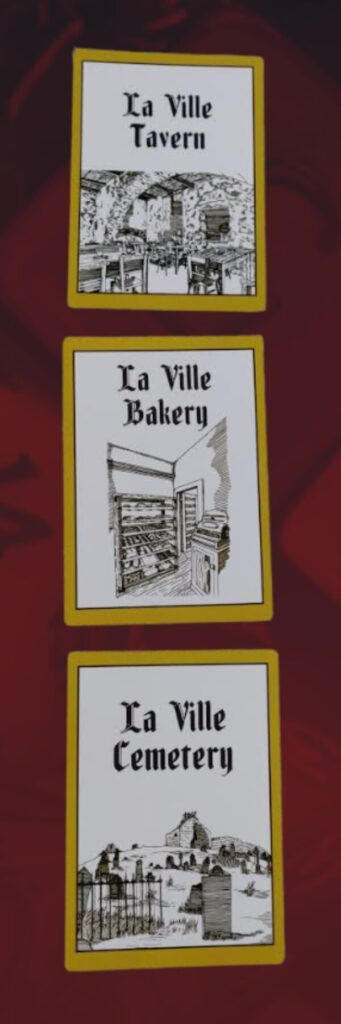
Monumental Consequences is set in a fictional European-style town where an invading army has set up in the local church… and then quite a bit else is going on. The army is destroying or stealing the church’s art and likely setting up a base for future operations. There’s subplots of others smuggling art AND bits of information scattered about on character cards that give more information about the greater plans of the army (and why it might be REALLY important to stop them here).
Using the information you have, you’ll debate amongst your other players to see if you want to try to get the army out and save the art within, which could end up as a risky fight OR if you want to bomb the church, killing those within and destroying what else may be in there.
It may seem like an easy choice from reading this here, but, through each pre-made character’s unique perspective and info on the art cards, you’ll learn that there may be some very important reasons to preserve the art, making this decision a bit more complicated than what’s shown on the surface.
Your character in Monumental Consequences
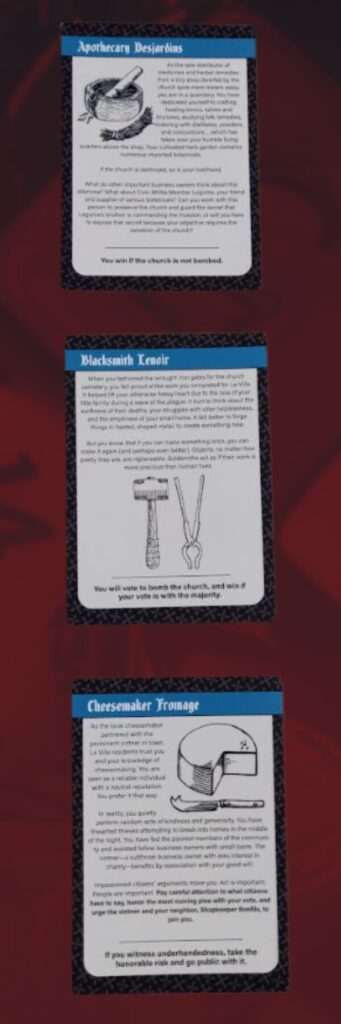
In Monumental Consequences, you’ll play a pre-made character from a character card that you receive at the start of the game. This card will have information about their backstory, values, goals, and any special instructions (like withholding your vote until a certain condition is met).
It will also let you know if you’re on a particular side of the argument and what your win condition is and why.
That “why” is REALLY important too. It’s what shows how everyone has different stakes. Win conditions include (but are NOT limited to): bombing the church BECAUSE you’ve witnessed what can happen if you let the army set up, saving the church BECAUSE you need to protect your livelihood, and saving the artifacts within BECAUSE they have value to you in some way.
Each character has enough story to give them a strong and believable motivation, and some characters even have hidden subplots or win conditions that aren’t revealed until the end…
It’s designed to quickly get you into character, give you your personal objectives and details for your role-playing in the debates, and let you take it from there.
Mechanics in Monumental Consequences
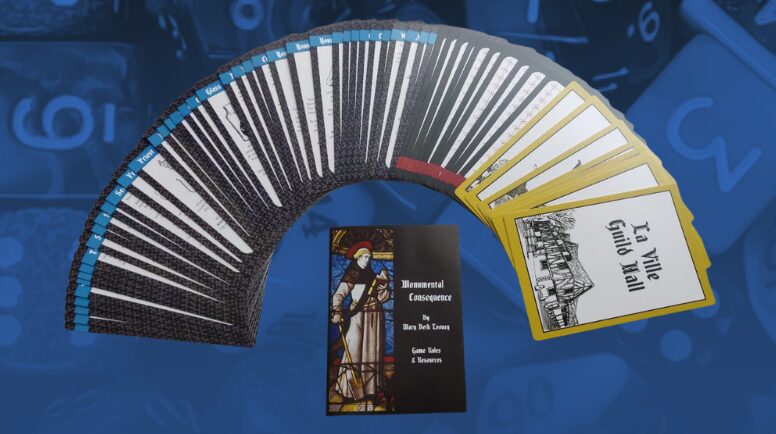
The mechanics for Monumental Consequences fit on a little pamphlet, and then the rest you kind of learn as you play based on your one particular card that you need to track.
For the facilitator, you’ll pass out the correct cards based on the number of players, set up the town’s location cards (things like the inn, bakery, market), lay out the treasure cards (representing what’s left in the church), and then manage rounds of debate.
They’ll set a short timer (3-5 minutes) for each round, and when a round of debate ends… if a decision has not been made, you’ll roll 2d6 to see what happens from a random roll table. This could include destruction of some of the art, army occupation of a new building, or even death of a PC.
The game ends through the group making a decision and then you, the facilitator, rolling to see how things play out (i.e. how successful you are in ousting the army, if any art survives, if subplots succeed) OR everyone losing because you couldn’t decide in time before the invaders overtake the town.
For player mechanics, you’ll be following what your card says and playing as your character, defending their motives or completing their personal goals, as you debate in those short 3-5 minute rounds between the army’s actions.
It’s meant to make your discussions feel urgent and impactful and quick by placing focus on fast-paced gameplay that has just enough rolls to keep things random but that won’t bog down the game’s core.
Overall thoughts on Monumental Consequences
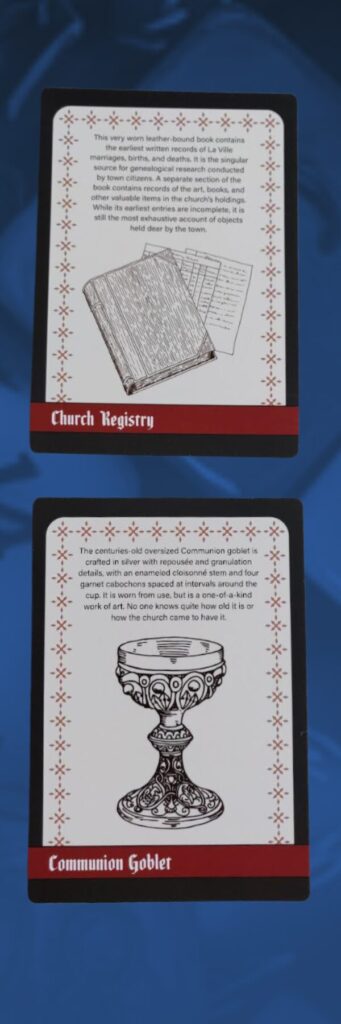
I really liked Monumental Consequences on so many levels. I like social deduction games in concept, but I don’t have a great poker face, and this is like a social deduction game where most characters don’t need to obscure their motives. You have a solid goal that you’re working towards, and you can be open about it (with few exceptions on some cards).
It’s also one of the few roleplaying games that I’ve come across that’s very intentionally designed for classroom use with its large player capacity, short timeframe, and low facilitator load. I think it took me about 10 minutes to read through the rules book, and I immediately got the concept and was able to see how each player card would operate. It’s the right level of clarity and complexity to keep things engaging.
And it is such a spark for more discussion! It answers questions like “why study art” or “what does art have to do with history” intuitively by letting the players engage in the debate in a fun way. They come up with their own answers, and, because they’re playing a character and not themselves sitting in class, there’s enough separation from the pure academia side and enough immersion in the fiction to allow it to be something fun. You’re also debating each other’s characters (and not each other), which can help with keeping the discussion friendly. It’s not HAVING to answer questions in class but GETTING to play a game and have a fun debate.
Find a copy of Monumental Consequences
If you liked this post, make sure to subscribe to the TTRPGkids monthly newsletter to stay up to date on the latest reviews, tips and tricks, game and podcast list updates, and more! Thank you for playing tabletop RPGs with your kids and sharing this awesome hobby with the next generation!