
Review: Beak, Feather, & Bone, a map-labeling RPG
Beak, Feather, & Bone tabletop role-playing game about making a map and building a city’s story together so you can then come back to it and play in this collaborative creation with the system and characters you want for further stories! See how this works and what is gained from this style of worldbuilding (especially when playing with young players)!
Note: This post may contain affiliate links. At no additional cost to you, I may earn a small commission from purchases made using them. TTRPGkids uses this to keep the site going. Read full disclosure here.
Jump to:
- Audience for Beak, Feather, & Bone
- Setting for Beak, Feather, & Bone
- Characters in Beak, Feather, & Bone
- Mechanics in Beak, Feather, & Bone
- Overall thoughts on Beak, Feather, & Bone
- Find a copy of Beak, Feather, & Bone
Audience for Beak, Feather, & Bone
Beak, Feather, & Bone by Possible World Games is not made for kids specifically, but is incredibly all-ages friendly in terms of how you can moderate the content and play. This means that this game works for adults, kids, and teens, so you can have mixed age groups at the same table while keeping everyone engaged.
The mechanics involve storytelling, writing, and totaling up card values with all core rules being laid out on about four pages with the remaining book including explanations of some extra info, very cool anthropomorphic bird art, lore about the ravenfolk, and a game transcript walkthrough to help with learning by example. For players who can’t write on notecards yet, other players may be able to help take notes so it isn’t a barrier to the creative elements of play.
Content easily adjusts to your table’s needs and the “content rating” that you establish when covering safety rules at the start of your game. Beak, Feather, & Bone works by giving you prompts that you interrupt and use for building the city’s story, so how bright, dark, cozy, or corrupt it goes is up to your table and not dictated by the game. You get to choose the content’s direction.
With all that, I would say that this could be used with kids 5+ with some assistance to help with writing longer thoughts out and with kids 8+ without too much help if they feel comfortable writing about 3 short sentences at a time.
Setting for Beak, Feather, & Bone
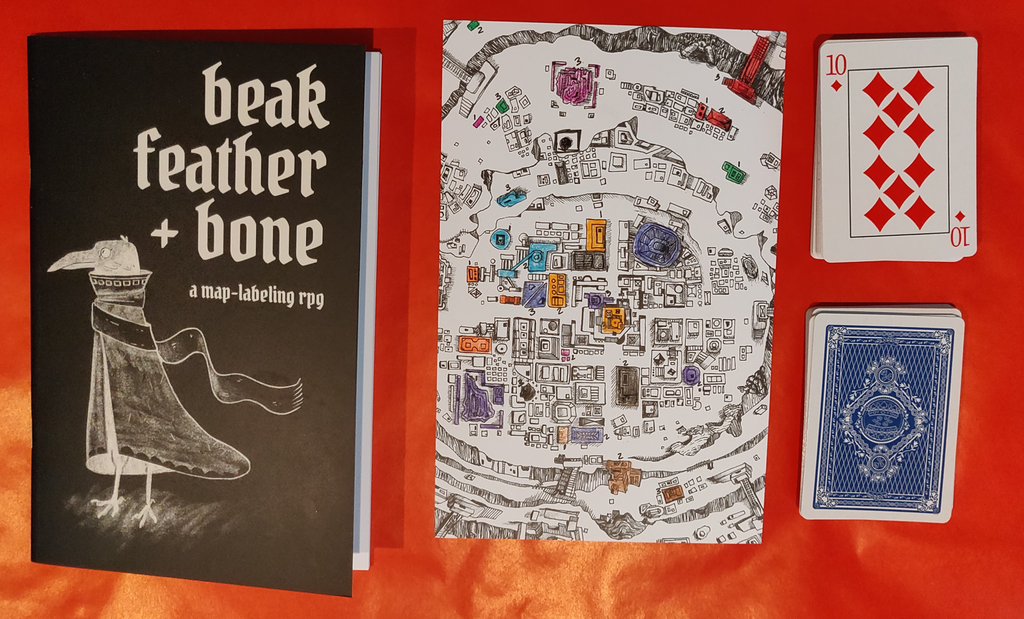
Beak, Feather, & Bone is set in the city of Kcha’Kcha, a resource rich desert city that is home to the ravenfolk. The city contains ten factions of ravenfolk who each have some level of influence over the city, and likely want to watch out for their group’s interests, but also are part of a whole group trying to survive and live their lives as a community.
There is some wonderful lore included in the book that takes common themes, ideas, names, and legends about ravenfolk from a number of other games and other stories and weaves them into a more nuanced background for the ravenfolk that calls out stereotypes and describes them as a people with varied needs and goals.
From here, it is up to you to create the city that a particular collective of ravenfolk have established. This is a game about you filling in the rest of the setting either for the satisfaction of building this city together or to use later as a setting for future games you may play with other characters who visit here.
Characters in Beak, Feather, & Bone
In Beak, Feather, & Bone, you represent one of the city’s factions instead of a particular character. As you get prompts to build up this city, you’ll be filling in parts of the map and story only that pertain to this faction’s influence and how they interact with the other factions.
You’ll be thinking about what this group of ravenfolk would want or need, how they would spend their time outside of work, what their goals are, what resources they would value and why, what their history is, and how they plan for future events.
It’s a different type of roleplay in that you are roleplaying as a large group seeking their place in the city, and you’re describing their actions through your descriptions of the locations they create and use instead of directly saying what they do. This method challenges players to think more broadly and consider how communities work and move together rather than focusing on one character and their individual connections.
Mechanics in Beak, Feather, & Bone
Beak, Feather, & Bone is primarily focused on storytelling… and on prompting and organizing that storytelling while also making it a bit of a competition.
First, players pick one of ten factions in the city, as mentioned in the character section, and will represent their interests when filling in locations on the map.
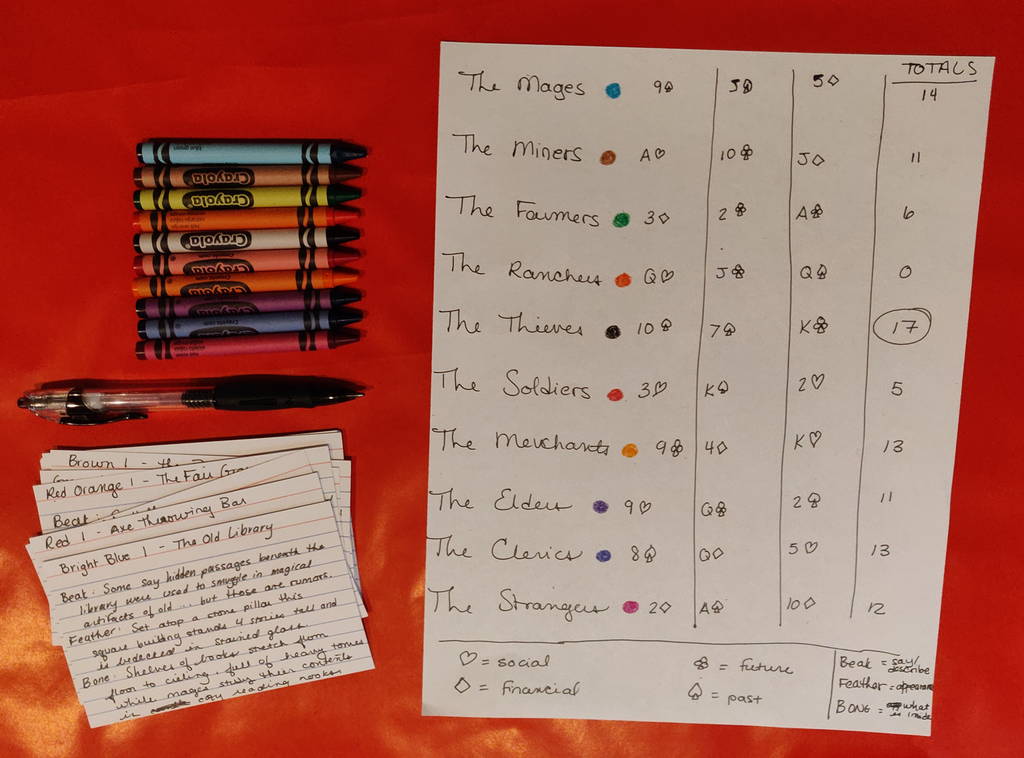
Players take turns drawing cards from a standard playing card deck to get a prompt based on the suit and points based on the card value.
They then color one building on the map and fill out a notecard for that building describing what the word around town is about this location (Beak), what it looks like (Feather), and what’s going on inside or what it represents (Bone).
If players draw a face card, they will, additionally, create an NPC from another faction who creates some drama with the player’s faction (because you need some key NPCs to bring this to life too).
You do this around the table for as many rounds as you want or can manage, then players total up all their card points to see which faction has the most power in the city! They get to color in the seat of power and are the ones actually running things here.
This structure results in you having a map that you can come back to explore later with characters in your typically TTRPG format. This map will have key locations to explore with plothook seeds that you can pick out from your descriptions on organized notecards for easy reference. You’ll also have NPCs that you’ve created together who you can either just interact with or use as a way to play with interfaction drama.
And everyone had a part in making this, so there’s buy in.
Whenever I include kiddo in the world-building process for our games or we make a map together, kiddo is WAY more interested in playing and continuing to come up with ideas.
This happens in the tweens group I GM for as well. The maps that I make are still fun for them, but they usually keep interest for about 3 sessions before I swap it out because they’ve hit all the things that seemed really interesting to them at first glance (even if they didn’t find all things I was excited for them to explore). I recently let them make their own map of a cave, populated by whatever they wanted to draw on it, and we’ve been exploring this for 8 sessions and counting. When their characters get to a new chamber of the cave, the players already know what’s in there, but they are so excited to rediscover it through their character and get to interact with the parts that they made.
It encourages everyone to flex their creativity and be part of the larger story, and I think that’s important for everyone, but especially for young players, to be able to feel the impact their ideas have had, be able to add to the group’s narrative in multiple ways, and feel a deeper connection to what they are creating together.
Overall thoughts on Beak, Feather, & Bone
I played two iterations of this game, one in solo mode, which I used for learning the game and taking pictures, and once with kiddo so I could have fun playing this together and see how it worked with multiple players. In solo mode I created a 10 faction city with some rivalries and fun buildings, but with kiddo, we made something more. The city had more whimsy and felt more exciting because there were different perspectives providing input, and I think that’s what this is all about.
I am a forever GM, partially due to my role with running TTRPGs in the house, but also partly because I really love world building. It’s one of my creative safe havens that I go to, and this feels like a way to share in that activity with others. That isn’t just me letting folks use my worldbuilding seeds for their sandbox. Everyone has equal stake, and that just feels whole to me.
It’s a great game that’s easy to learn, it has the right balance of collaboration and competition, the art is wonderful, it’s tactile, it’s imaginative, and it’s also just something fun to play with your family and friends.
Find a copy of Beak, Feather, & Bone
You can find Beak, Feather, & Bone here on DriveThruRPG!
If you liked this post, make sure to subscribe to the TTRPGkids monthly newsletter to stay up to date on the latest reviews, tips and tricks, game and podcast list updates, and more! Thank you for playing tabletop RPGs with your kids and sharing this awesome hobby with the next generation!