
Review of Star Trek Adventures the Roleplaying Game
As a lifelong fan of Star Trek, I am happy to share with you a review for Star Trek Adventures! I covered the Quickstart Guide here to give you a summary of the game, and I hope you enjoy checking it out with me!
*This post may contain affiliate links. At no additional cost to you, I may earn a small commission from purchases made using them. TTRPGkids uses this to keep the site going. Read full disclosure here.
- Audience for Star Trek Adventures
- Setting for Star Trek Adventures
- Your character in Star Trek Adventures
- Mechanics for Star Trek Adventures
- Overall thoughts on Star Trek Adventures
- Find a copy of Star Trek Adventures
Audience for Star Trek Adventures
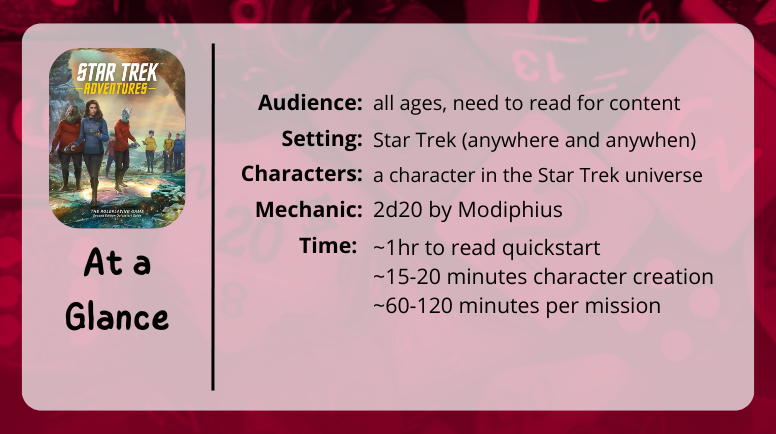
Star Trek Adventures (2e quickstart and game toolkit) is obviously aimed at folks who probably like Star Trek, but you don’t need to be a super fan to be able to play. The vibes are what’s important here, so you can play without knowing all the lore, and I think it would also be a great vehicle for sharing Star Trek with friends who maybe don’t want to commit to watching a new show but who are cool with playing a game together.
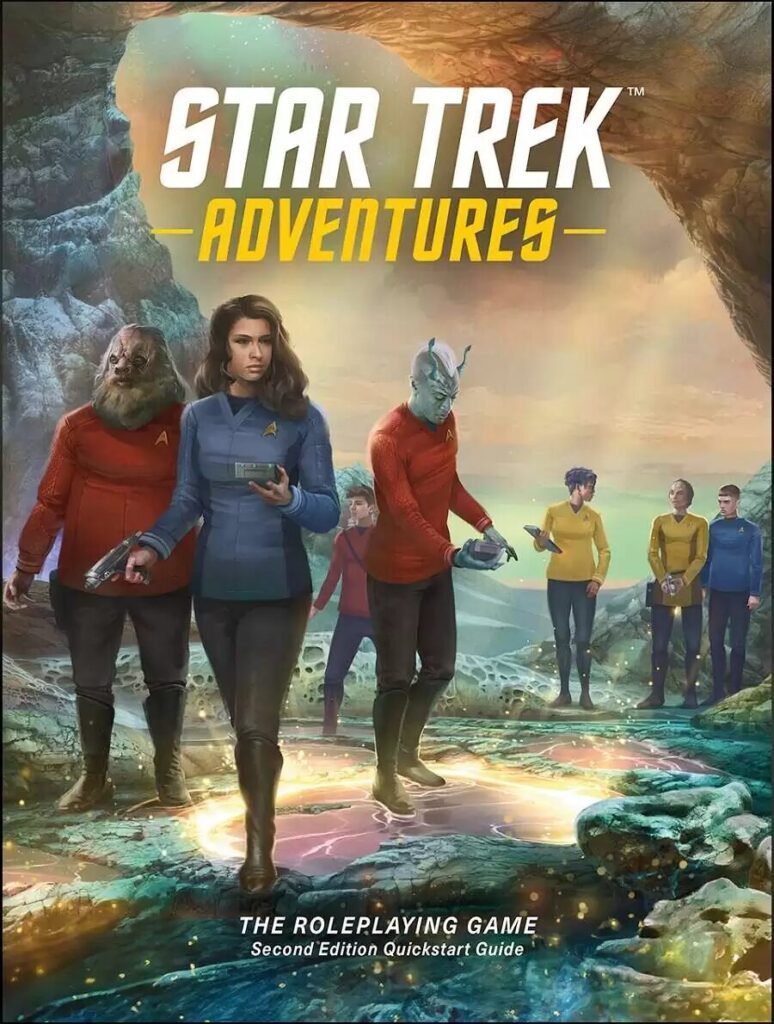
Like with the show, Star Trek Adventures is versatile in the types of stories that you can tell, ranging from entirely diplomatic events to uncovering strange discoveries in new and interesting locations to exciting combat sequences. YOU get to decide where it goes, and the game is built to be able to fit all of those forms, meaning you can tailor the content to your group.
For the mechanics, the base is pretty easy to understand; it is a bit more complex than just this, but, at its core, there’s the addition of a few modifiers and then rolling a dicepool versus that target number. You have some resources to track (Momentum and Threat), and there are more bits for specific situations, particularly in combat, but the core was easy to pick up.
All that said, and because it is TTRPGkids, I would say that content can be easily made all-ages friendly, and players who can read for content should be able to engage with the game on their own, especially if starting with the Quickstart Guide.
Setting for Star Trek Adventures
Star Trek Adventures is, as you may guess, set in the Star Trek universe. It spans all eras of Star Trek, so you can jump into any show or pick time periods in between and after the TV/movie content.
The mechanics are structured around the feel of Star Trek too. While I’ll discuss more on mechanics later, I think it is quite critical to the setting that the mechanics do what they can to tie into the themes of the game as not every game does this. It prioritizes impact on scenes and people, your character and how they use their skills as a competent person to handle the situation, using a wide variety of skills, defeat by injury versus killing (unless you specify a deadly attack), rewarding sticking to your character’s values, and so on.
Your character in Star Trek Adventures
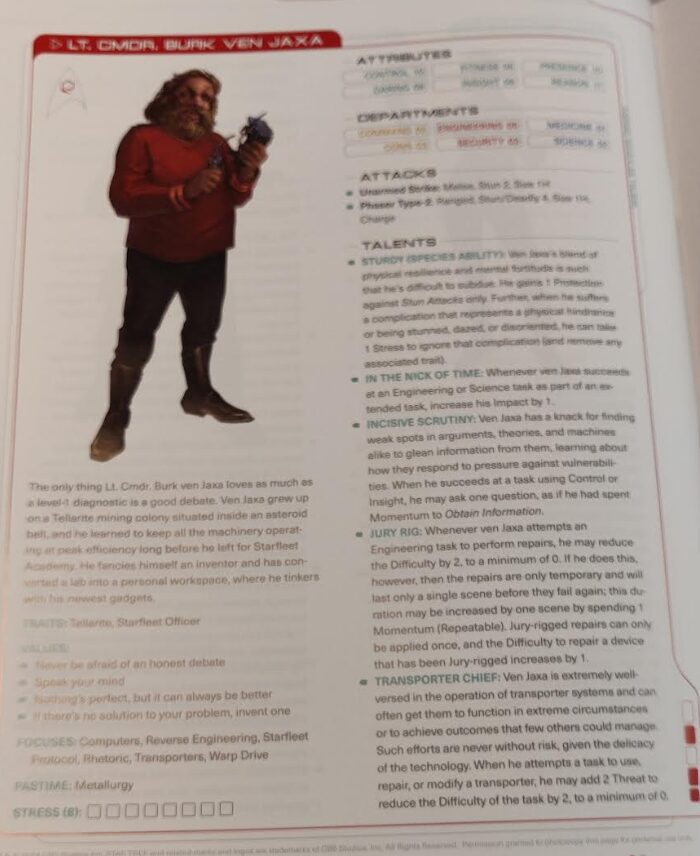
Your character in Star Trek Adventures can be pretty much any type of character that you would find on a Starfleet vessel. There’s a list of pre-gen characters included in the Quickstart Guide that give examples for several officers in a crew, but I also know from playing Captain’s Log that you can probably branch out quite a bit from the officer story and create other characters that fit too (like Garak in DS9).
To make your character, you’ll assign them stats for their six Attributes and six Departments, and you’ll give them a set of Focuses and Talents, or expertise and special abilities. These will all factor into your rolls and storytelling for your character… and they all fit on one half of an 8.5” x 11” page.
Character information is easy to view and track in the sheet without requiring a ton of searching for lots of numbers or sifting through long lists of special moves. You’ll have two small blocks of stats to watch out for, a concise little block about your attack abilities, a short list of Focuses, and then about five Talents with a couple sentences of text each. You’ll definitely want to be familiar with your Talents, but I also found this to be pretty easy to remember when there’s only five to keep in mind, and they’re easy to look up on the sheet.
Mechanics for Star Trek Adventures
For this section, I’m going to cover the basic elements of gameplay, but, like usual, I can’t rewrite it all, so I’ll summarize things like combat details or may pass over some special rolls that only show up in specific cases (like rerolls or rolling for zero rating challenges).
In general, when you want to make a roll, you’ll build up a dicepool of d20’s and roll versus a target number, calculate your successes and crit fails, compare your total number of successes to the rating set by the GM, and implement any repercussions from failures.
To build your dicepool, you’ll start with 2d20 and then add up to 3 more dice by spending Momentum (an earned resource), getting help from others, giving the GM Threat points (explained later), using your Determination (earned by taking actions aligning with character values), etc.
To get your target number, you’ll pick your Attribute and Department that best match the task and add them.
You’ll then get a success for every roll less than or equal to your target number (so rolling low is good). You can earn a double success if you roll below your Department number for something you have a Focus in. If your total number of successes is greater than or equal to the rating set by the GM, you do the thing! And you earn Momentum if you get extra successes!
If you roll a nat20… that’s a critical failure and will add some kind of narrative complication to the scene, which the GM can use to make things more interesting (Q chuckles somewhere out there in space).
I liked this flow of mechanics because your strategy primarily lies in a combination of resource management and finding the best way to work together by picking the right person on the team for a specific job. You also have a ton of Attribute + Department combinations that add freedom and flavor to the story while having you only track a short list of stats. When it comes to the math, you have two numbers to add and then you compare to your dice, so turns move pretty quickly too since folks aren’t trying to count up a whole bunch of dice or roll multiple times within a turn.
In combat, it also sticks to the d20 pool, choose your stats combo, and roll sequence, but it may be compared to an NPC’s dicepool of successes, a challenge rating set by the type of attack (versus the GM), etc. Still though, it is roughly the same base, so you don’t have to learn a totally different style of play because you’re in a different phase or mode of the game.
Before moving on, I did want to talk a little bit more about two additional elements in the game: Momentum and Threat.
Momentum is a collective resource pool that the players can utilize to help get more information (i.e ask the GM a question), buy more dice for important rolls, alter the scene by creating a trait, adjust the initiative, etc. These are earned by rolling extra successes, and they give some pretty hefty bonuses, so it’s important to use them at opportune times.
The “foil” to Momentum is Threat. This is a resource pool for the GM to use to spend on scene elements, like giving an NPC an advantage or introducing some kind of danger. The GM starts out with a pool proportional to the number of players… and the players give the GM more Threat to buy extra dice when they can’t do so by other means but need to. It can also be generated through critical failures (rolling a nat20).
And I think these two mechanics are very key for much of the game’s feel.
It lets you build up excitement over time, starting your episode of Star Trek Adventures out with probably a slower pacing, giving you time to figure out what’s going on, and then letting you roll into the conclusion with big action scenes, critical discoveries, and “aha” moments against a similarly building tension and drama from the GM.
It gives you opportunities to impactfully strategize while only having to manage two resource pools, keeping the rules light but giving you LOTS to think about when planning for the adventure as a whole.
AND it promotes teamwork. Momentum is a collective points pool and Threat a pool that is used in the scene that the players are all playing in. If one player decides to utilize one of these resources, it directly impacts the whole group, so there’s a significant incentive to collaborate, which… I don’t know what’s more Trek than that.
Overall thoughts on Star Trek Adventures
As I’ve said before, I grew up watching Star Trek, and it was easily one of my “things” before TTRPGs, so I have a particular interest and love for content that captures the feel of Star Trek… and I felt that this did just that.
I can see where the mechanics support the show’s themes and recognize the episode structure in how the adventures flow. I get how character builds create skilled people who have already proven themselves capable and are really only going to fail if they’re crunched on time, are faced with some kind of abnormal obstacle, or the chance of the universe comes down upon them.
There’s opportunities to explore the Star Trek universe as we know it or venture further to create and share our own stories that still carry the optimism, excitement, and wanderlust from the series with friends and family, and I’m glad I had the opportunity to check this out.
Find a copy of Star Trek Adventures
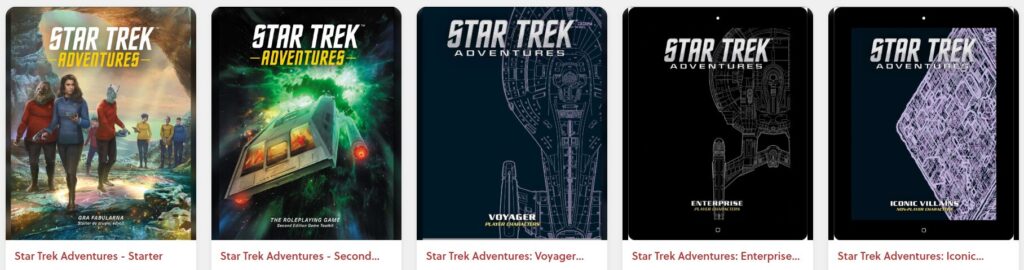
You can find a copy of Star Trek Adventures 2e Quickstart here!
And, if you want to get the full game, check out the Star Trek Adventures Game Toolkit!
If you liked this post, make sure to subscribe to the TTRPGkids monthly newsletter to stay up to date on the latest reviews, tips and tricks, game and podcast list updates, and more! Thank you for playing tabletop RPGs with your kids and sharing this awesome hobby with the next generation!