

Review of Let’s Go to Roomino!
Explore endless dungeons and bring everyone in on the fun in this ROOMS maker and adventuring game specifically made for engaging young players with awesome stories!
Note: This post may contain affiliate links. At no additional cost to you, I may earn a small commission from purchases made using them. TTRPGkids uses this to keep the site going. Read full disclosure here.
Jump to:
- Audience for Let’s Go to Roomino!
- Setting for Let’s Go to Roomino!
- Characters in Let’s Go to Roomino!
- Mechanics in Let’s Go to Roomino!
- Overall thoughts on Let’s Go to Roomino!
- Find a copy of Let’s Go to Roomino!
Audience for Let’s Go to Roomino!
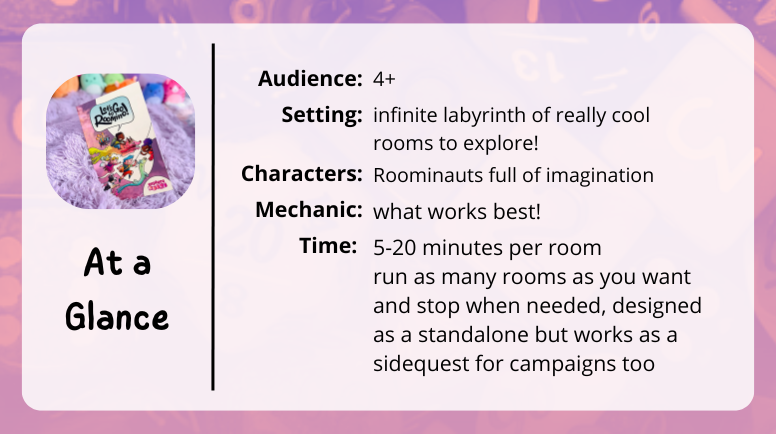
Let’s Go to Roomino! is an ENnie nominated tabletop RPG dungeon crawler that’s made for ages 4 and up with cozy and lighthearted adventuring vibes. The focus is on storytelling, problem-solving, and discovery with a clear structure to allow for creating simple, but not simplistic, on the fly.
Because of that, it’s also made for facilitators/families to be able to quickly create engaging and flexible scenes for players to explore for as long or short as they want since the ROOMS in Roomino connect with each other but are modular enough to also stop at any point while still giving a satisfying exit.
I’d say the 4+ age recommendation is perfect for this, and I really appreciate having a game that, as the facilitator, is quick to learn, explain, and use as well.
Setting for Let’s Go to Roomino!
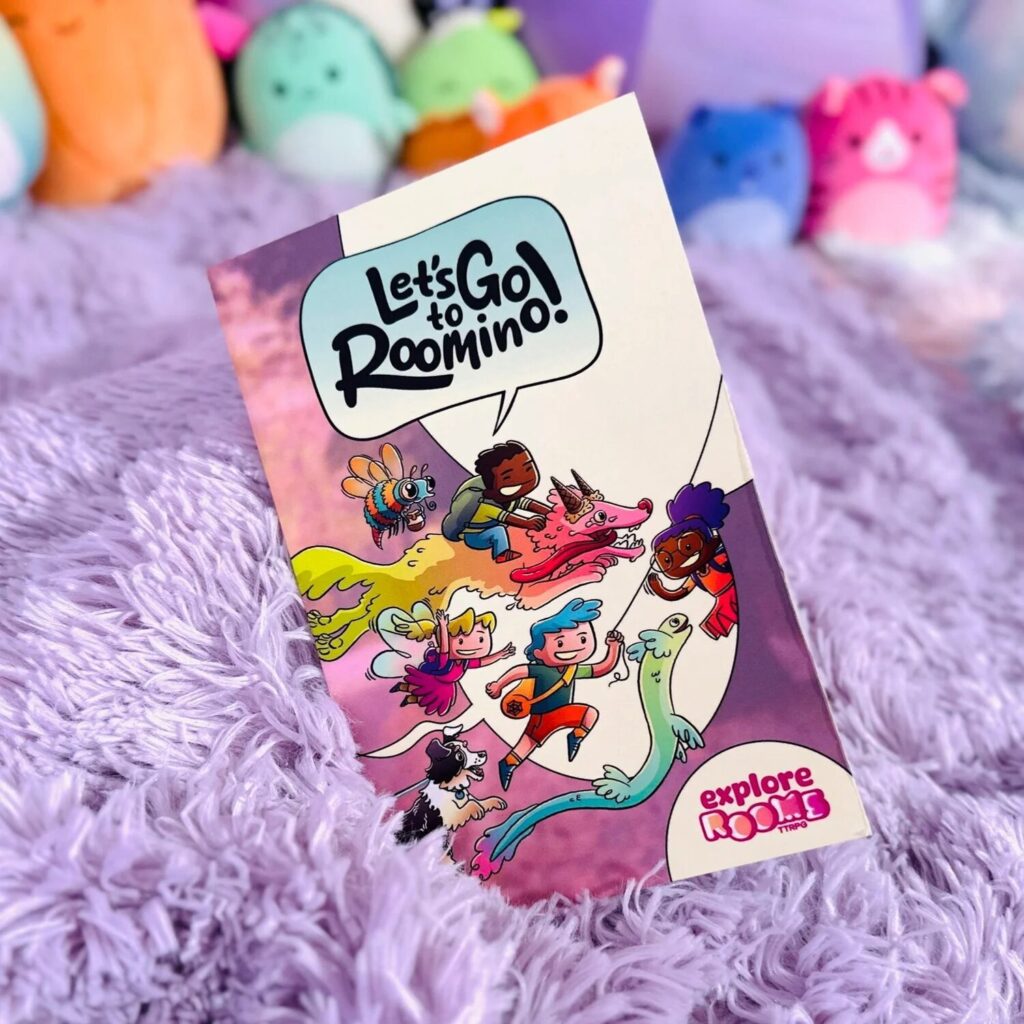
Let’s Go to Roomino! is set in a labyrinth of curiously connected rooms that provide an endlessly wonderful place to explore for however long the gaming group wishes to. There’s no overall map, unless you want one, so rooms can flow from one to the next, you can play the maze as being able to shift as you adventure onward, and the exit can appear whenever players are tired and want to take a break.
It’s fun, flexible, and exciting without the need for an overarching story, however, it is also REALLY easy to add more story onto this.
The dungeon could contain a prize as part of the main quest in an existing game, and you have to dive in to retrieve it, or maybe this is a standing sidequest area in your bigger campaign that lets players dip in whenever they want to search for loot that will help them on their other adventures. It can fit into other games or work as a standalone, which affords lots of opportunities for integrating into different settings, as you wish.

Characters in Let’s Go to Roomino!
Your character in Let’s Go to Roomino! is Roominaut who gets to be super creative and has some awesome magical gear to help them with that!
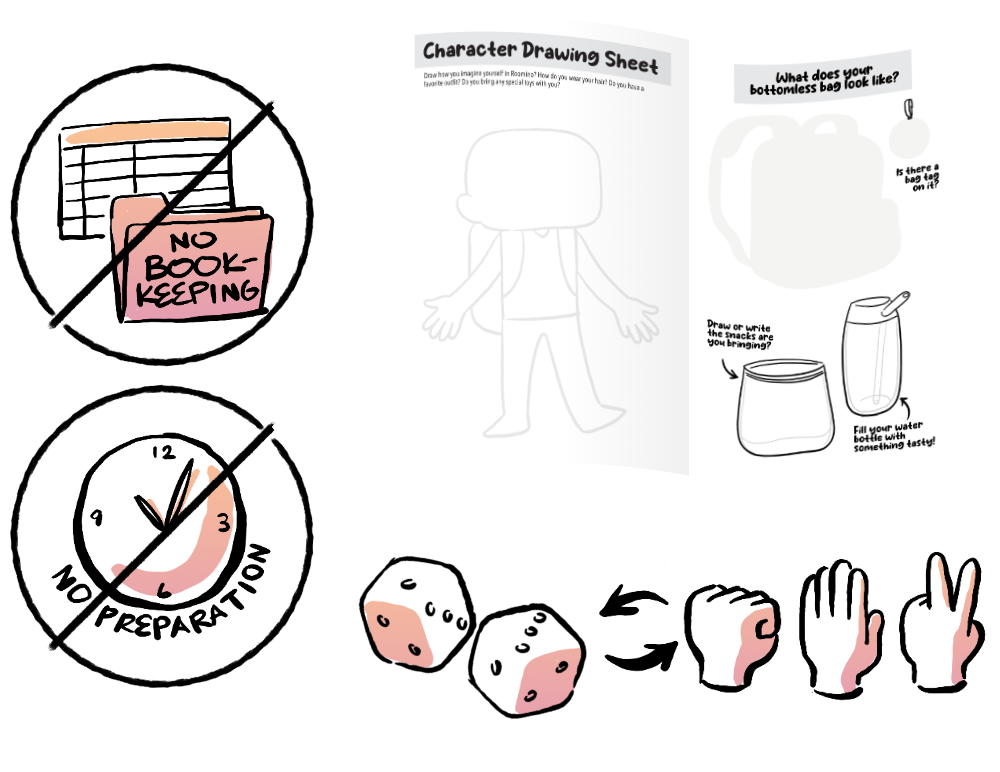
Players can make their character up however they want and don’t need to create stats. Each PC has an infinite backpack, TONS of snacks to use as they wish, and a magic gumball that can turn into any simple object that they wish!
This takes away a lot of common pitfalls that we’ve run into when playing TTRPGs (tracking, decision paralysis on character classes, reading requirements before kiddo could read, etc) that lowers the entry bar so really young players can join in on the fun. It also focuses strongly on the creativity and storytelling angle of the game, encouraging kids to think about the puzzle in the room, ask questions, and then act out whatever idea they want to try.
For example, if there’s a keyhole on the ceiling, they may want to search the room for a key by turning their magic gumball into a metal detector and then get to the ceiling by standing on each other’s shoulders… and it makes total sense to do that given the way the game and characters are set up!
The character sheet is picture based and easily understood through the images even if players are still learning to read. Additionally, players get to color their character! This is always a great way to engage with PCs early in the game so they feel special right from the start.

Mechanics in Let’s Go to Roomino!
Let’s Go to Roomino! is, to me, primarily a dungeon builder that is really honed in on making dungeon crawls fun for kids. Each room is broken down into:
Reveal, One thing, Offer space, Mediate, and Surrender, so ROOMS, which boils down to creating a basic description of the room, putting a point of interest in the room that players must solve (like a puzzle, item, or having the exit way out of reach), asking players what they want to do, seeing if that matches the trigger for getting out of the room/playing out challenges, and then eventually exiting the room.
It’s a very clear process to follow that lets you quickly come up with something cool to explore and then have a method for dialogue to handle it.
That said, it does also have a way to solve challenges, and this was really fun.
The mechanics are what fits best for the challenge and what you have.
The game lists ideas like flipping a coin, rolling a die, drawing a card, using rock, paper, scissors, and more. It’s whatever works best for the situation or that you have on hand, and that makes A LOT of sense. The focus is on the creative storytelling and problem solving aspect, and there’s no character build modifiers to really require specific mechanics, so using whatever randomization method clicks with your kid… works.
Overall thoughts on Let’s Go to Roomino!
Let’s Go to Roomino! really vibes with me on multiple levels. It’s super easy for introducing TTRPGs to new players, it was quick to read and process, I was able to explain the rules and set up in under a minute so we could immediately start playing, and the ROOMS framework is super intuitive and helpful for continuous gameplay.
Also, the art is fantastic. It’s great for conveying the feel of the game through images so you know you’re in for something lighthearted and exciting, but then… it gives SO MANY ideas for rooms without having to spell them all out! There’s depictions of mechanical puzzles, creatures, logic traps, and more that are just good solid idea sparks.
Overall, Let’s Go to Roomino! is meaningfully concise and clear while conveying a bounty of whimsy. I can see the intention that was put into this and am really excited that this game is out there in the world.
1 thought on “Review of Let’s Go to Roomino!”